
Glossary
Most of this vocabulary gets learned the hard way, by being the one person on the truck who does not know what a DOOD is. Here it is written down. Plain definitions, and the part that actually matters once you are on the day.
Script and breakdown
Lookbook
A lookbook is a short visual document, a few pages to a few dozen, that shows how a film will look and feel through reference images, color palettes and notes on tone, light and camera.Revision colors
Revision colors are the page colors a script cycles through as it changes during production. The shooting script starts on white, the first revision is blue, and the order continues pink, yellow, green, goldenrod, buff, salmon and cherry.Script breakdown
A script breakdown is a scene-by-scene inventory of everything a production has to supply. You read the script once, tag every prop, costume, vehicle, stunt and actor, and come out with a list you can schedule and cost from.Sides
Sides are the few script pages a crew actually carries on the day: only the scenes scheduled for that day, printed small enough to fold into a back pocket.Slugline
A slugline is the capitalized line that opens a scene, in the form INT. MOTEL ROOM – NIGHT. It carries three things, and most of what a schedule does downstream depends on them.
Scheduling the shoot
Call time
A call time is when a person is due on set, and a call sheet carries several of them. Crew call, also called general or unit call, is when the whole crew is due to start the day. Shooting call is when the camera should roll on the first shot.Company move
A company move is moving the whole unit, cast, crew, equipment and vehicles, from one location to another in the middle of a shoot day.Day out of days
A day out of days, usually called a DOOD, is a grid of every cast member against every shooting day. It marks the days each actor starts, works, is held and finishes, and it is what determines what they get paid.Page count (eighths)
Page count is how much script a scene represents, measured in eighths of a page. It is the unit the industry uses to estimate how long a scene will take to shoot.Stripboard
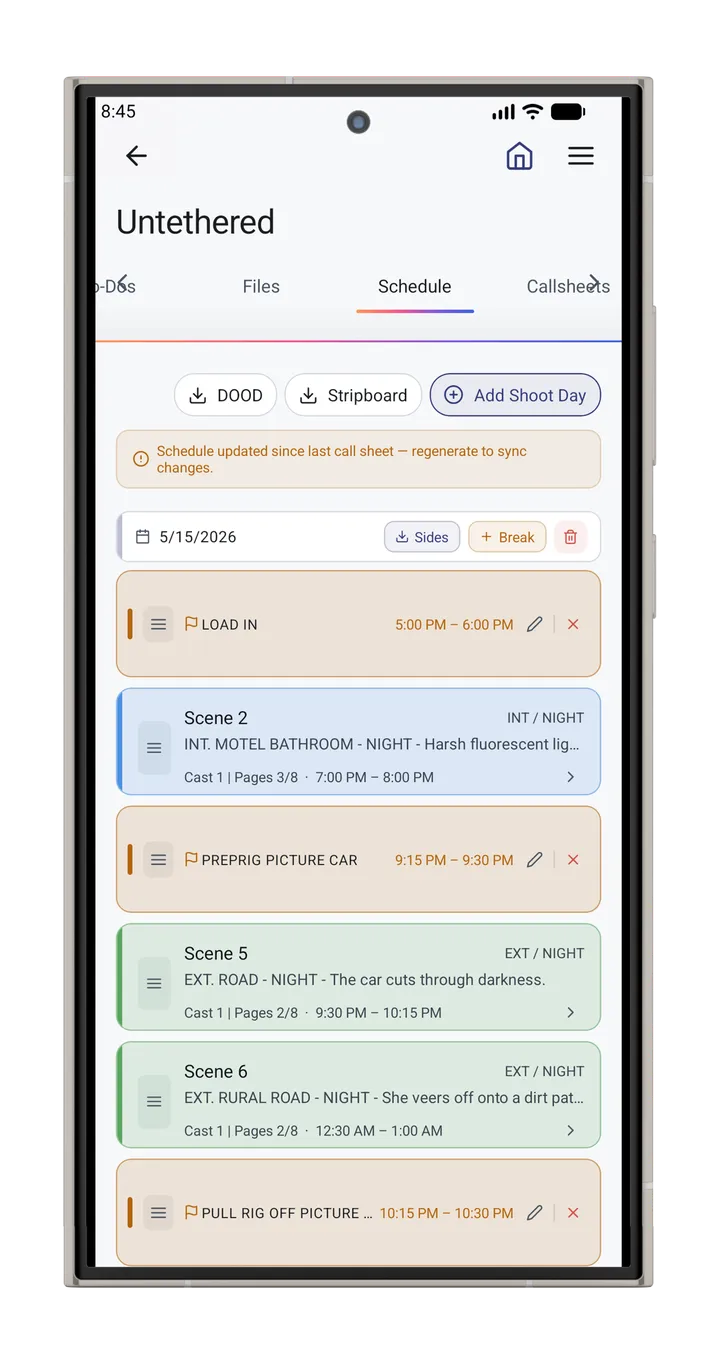
A stripboard is a shooting schedule in which every scene is one colored strip. The order of the strips is the order you plan to shoot, which is almost never the order the scenes appear in the script.
Camera and light
Beam angle
Beam angle is the width of a light’s spread, in degrees, usually measured to the points where its output drops to half of what it is at the center.Coverage
Coverage is the set of shots a production takes of a scene, usually a master plus singles, over-the-shoulders, two-shots and inserts, so the editor has the angles to cut it together.Depth of field
Depth of field is the distance between the nearest and farthest things in a shot that look acceptably sharp. In cinematography it decides how much of the frame is in focus around the actor, and everything outside it falls off into blur.Golden hour
Golden hour is the stretch just after sunrise and just before sunset when the sun sits low enough that the light goes warm and soft. Roughly, it runs from the horizon up to about six degrees of solar altitude.Hyperfocal distance
The hyperfocal distance is the focus setting at which everything from half that distance out to infinity reads as acceptably sharp. Focus there and you have the deepest field that lens and stop can give you.Lighting diagram
A lighting diagram is an overhead plan of a setup: the space drawn from above, with the actors, every camera, each light and its modifier, the grip control and the cable runs, so the electric and grip departments can rig it before the cast arrives.Storyboard
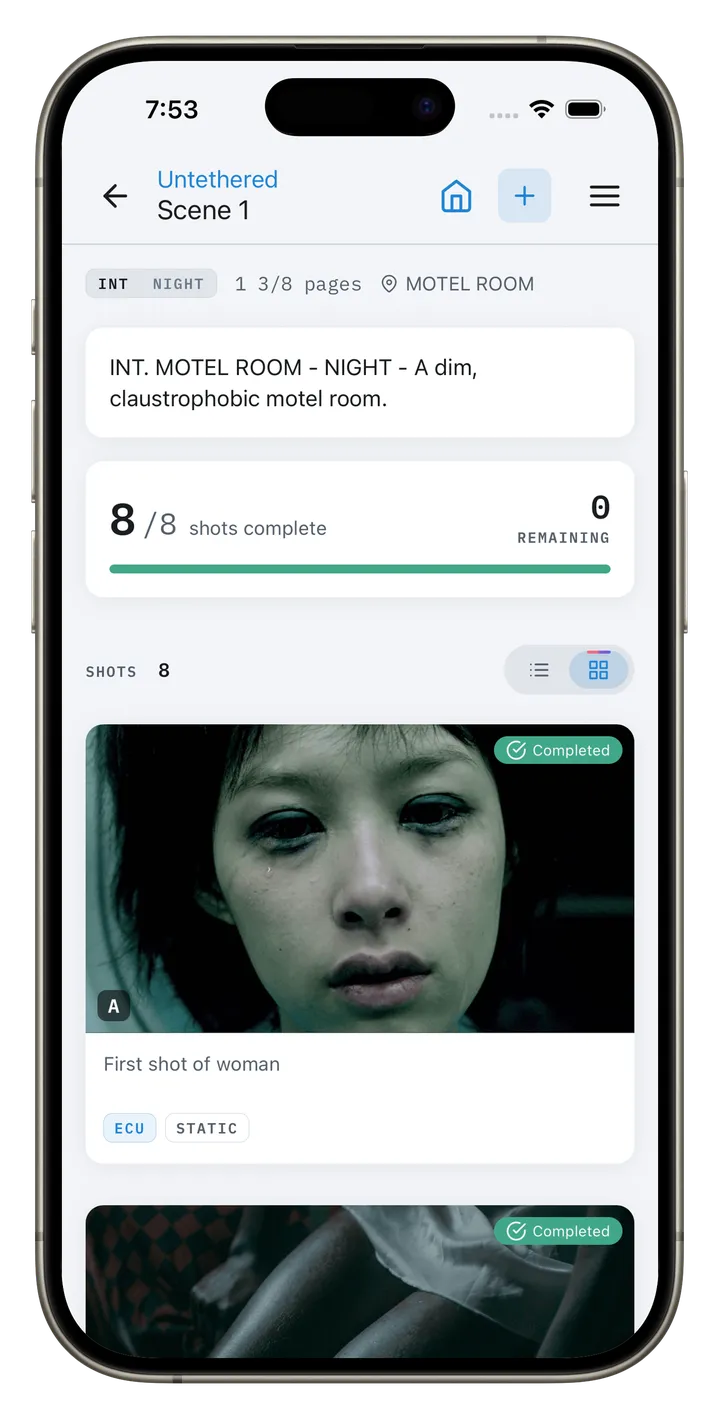
A storyboard is a sequence of drawn or photographed frames showing what each shot will look like. It answers what is in the frame. A shot list answers how you get it.
Reports from the day
Camera report
A camera report is the sheet the second AC fills for each card or magazine, recording how every setup on it was shot so post can reproduce or match the image later.Continuity log
A continuity log is what the script supervisor hands editorial at the end of the day: every setup and take, which one to print, and the notes that keep a scene shot over three days looking like one moment.Daily production report
A daily production report, or DPR, is the sheet the production office files at the end of every shooting day: what was scheduled, what was actually shot, and the gap between the two.Unit list
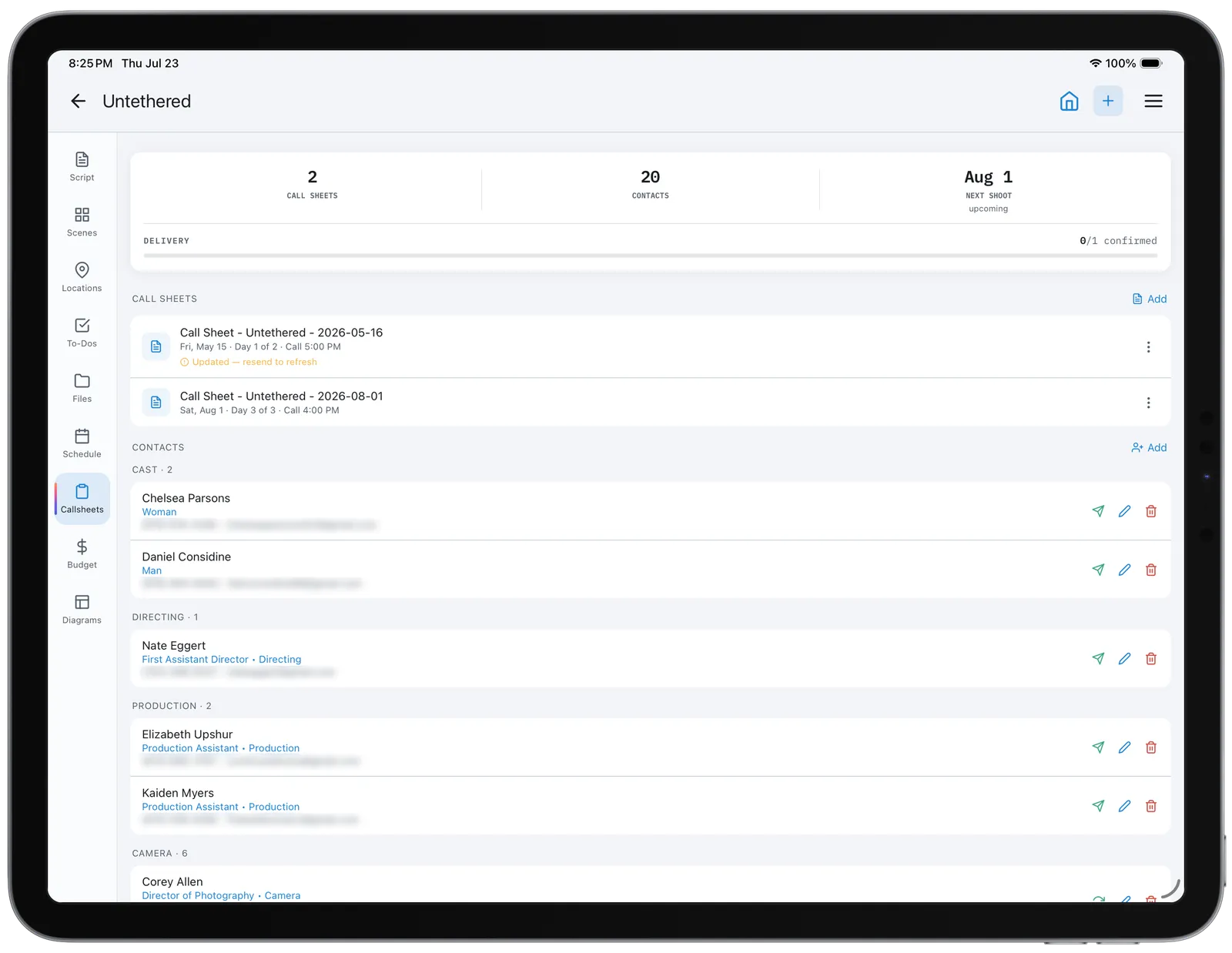
A unit list is the contact sheet for a production: every department, every name, and the number that reaches them, carried behind the call sheet and in every glovebox on the show.Wrap report
A wrap report is the summary filed when principal photography ends: how many days it took, how much of the script was covered, what was carried to pickups, and what it cost against the budget.
Budget
Above the line vs below the line
Above the line covers the creative deals struck before production: story rights, writer, producer, director and principal cast. Below the line covers everything it takes to execute them, which is crew, equipment, locations and the shooting days themselves.Fringes
Fringes are the payroll costs that sit on top of a wage: federal and state taxes, union pension and health contributions, workers compensation, payroll service fees. They are why a $1,000 day does not cost $1,000.Purchase order (PO)
A purchase order is a numbered commitment to spend, issued to a vendor before the invoice arrives. On a film budget it is what turns money you intend to spend into money you have already promised.Top sheet
A top sheet is the one-page summary at the front of a film budget. It shows the totals for each account group, above the line, below the line, post and other, and the grand total.
After the longer version? The guides walk through call sheets, shot lists and location scouting end to end.