
Home / Guides / Film Pre-Production Checklist
Film Pre-Production Checklist
Pre-production is the stage between development and production: development settles the idea, script, financing and package, production is the shoot, and pre-production turns the first into a plan that can execute the second. The checklist below covers every step, ordered by what blocks what rather than by importance.
That ordering is the whole point. Most pre-production checklists give you fifteen to seventeen items in roughly the right sequence and leave you to discover the dependencies yourself, usually at the moment one of them bites. You cannot budget before you break down the script. You cannot break down before the script locks. You cannot tech scout before locations are secured, and you cannot secure locations before you know how many shoot days you are paying for. When prep compresses, knowing the graph is what tells you which corners are safe to cut.
How Long Pre-Production Actually Takes
The most-asked question about pre-production, and the one most guides skip.
| Production | Typical pre-production | What sets the floor |
|---|---|---|
| One-day corporate or commercial shoot | About a week | Location and crew availability |
| Short film | Four to eight weeks | Casting and locations |
| Independent feature | Eight to twelve weeks | Financing close, then casting |
| Studio feature | Several months | Cast deals, build periods, VFX design |
| Documentary | Months before a first interview | Research, access and subject trust |
Sources broadly agree on this shape: a one-day shoot needs roughly a week of prep, a short film four to eight weeks, and a documentary can spend months in research before rolling.
The floor is almost never the paperwork. It is the two things you do not control: when the money closes and when your cast is available. Everything else compresses under pressure; those two do not.
The Dependency Order
Read this as "you cannot start B until A is done":
- Script lock, then breakdown, then schedule, then budget.
- Budget before crew size, gear package, and the number of shoot days you can afford.
- Breakdown before department needs: art, wardrobe, stunts, VFX lead times.
- Schedule before cast availability is confirmed, and both before location booking dates.
- Locations secured before the tech scout, which comes before the shot list is final, which comes before call sheets.
- Almost everything before insurance and permits, which need specifics and take real calendar time.
Two dependencies are routinely missed and cause the most damage:
- Insurance and permits need the schedule, and both take longer than anyone expects. They get treated as paperwork to file at the end, but a permit office works on its own timeline and a location cannot be confirmed without proof of insurance. Start them the moment the schedule stabilises.
- Specialist elements need lead time rather than budget. A stunt, a trained animal, a period vehicle, a VFX plate: these have booking windows measured in weeks. The breakdown is what surfaces them, which is why getting the breakdown done early matters more than it appears.
Phase 1: Lock the Foundation
- Lock the shooting script and number the scenes. Post-lock revisions get letter suffixes and OMITTED markers so nobody's paperwork shifts silently.
- Confirm the money. Not expected, confirmed, with dates. Every decision downstream assumes it.
- Set up the production entity: company, bank account, and whatever payroll arrangement the production needs.
- Hire the key production heads, at minimum a line producer or UPM and a 1st AD. Doing the breakdown and schedule yourself is possible. Doing them well without an AD is not.
Nothing else should start before the script locks. Breaking down an unlocked script means doing it twice.
Phase 2: Break Down and Cost
- Break down the script: tag every element each scene requires and measure scenes in eighths of a page. This is the step that converts a screenplay into a list of things that can be priced and scheduled. See the script breakdown guide.
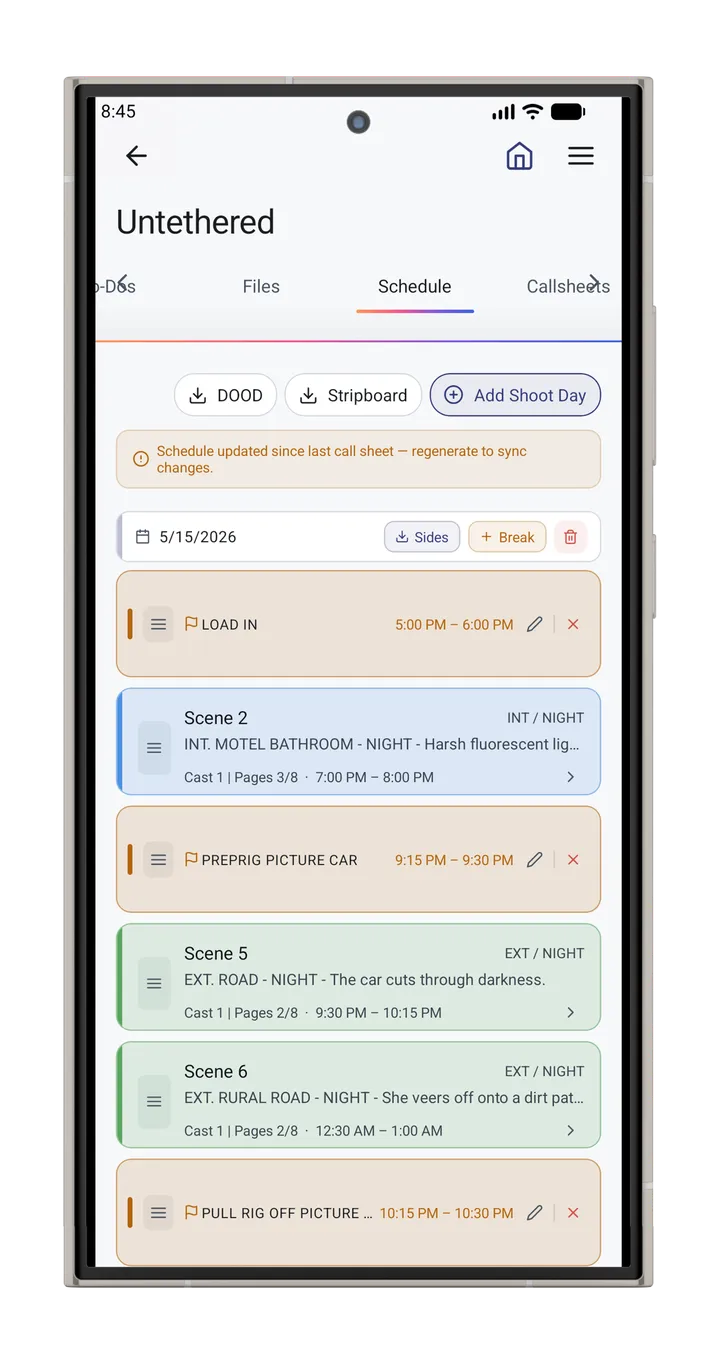
- Build the schedule. Group scenes by location and by day or night to minimise company moves, then reconcile against cast availability and daylight.
- Finalise the budget. The breakdown gives you the categories, the schedule gives you the days, and the cost follows from both.
The schedule and the budget are really the same document argued from two directions. Changing one always changes the other, and any tool or process that keeps them apart will eventually let them disagree.
Phase 3: Cast, Crew and Secure
- Cast. Casting drives the schedule as much as the schedule drives casting, and one actor's availability window can reorder the whole board.
- Scout and secure locations. Secured means signed and insured, not that the owner seemed fine with it. See the location scouting guide.
- Crew up below the line, in the order each department needs lead time.
- Start the art department. Builds, dressing and prop sourcing have the longest tails of anything the breakdown surfaces.
- File permits and insurance. Here, not in the final week.
Phase 4: Design the Shoot
- Storyboard what needs it. Not everything does. Action, VFX and anything a client has to approve does.
- Build the shot list, one row per setup, with the coverage the director and DP have agreed. A shot list template is enough on a small show.
- Tech scout with the department heads. This is where the shot list meets reality and gets shorter.
- Lock the gear package against the shot list, not against a wish list.
Phase 5: Final Week
- Distribute the schedule to cast and crew with enough notice for people to raise conflicts.
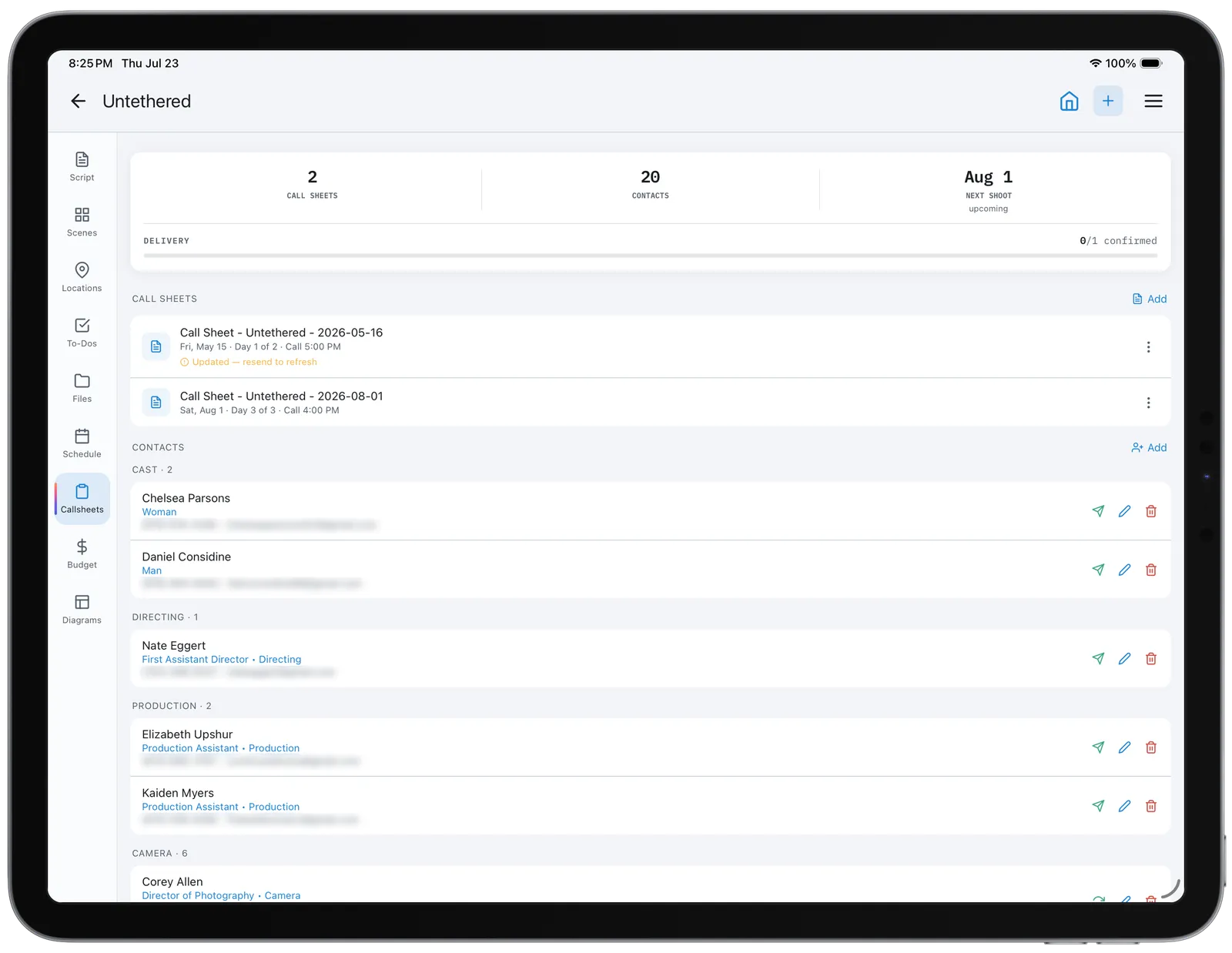
- Build the first call sheets. They go out the night before each shoot day. See the call sheet guide.
- Confirm everything twice: cast, locations, gear, catering, parking.
- Walk the contingencies. Weather cover, a cast member falling ill, a location cancelling. The plan does not need to be elaborate. It needs to exist before it is needed.
What to Cut When You Have Two Weeks Instead of Eight
Compressed prep is the normal case, not the exception. What survives and what goes:
| Never cut | Cut first | Why |
|---|---|---|
| Script lock | Full storyboards | Boards can be a shot list plus reference frames |
| Script breakdown | Extensive casting rounds | Breakdown drives everything downstream |
| Schedule | Elaborate lookbooks | The schedule is the shoot |
| Insurance and permits | Rehearsal | Legal exposure and immovable timelines |
| Location agreements | Second-choice scouting | A collapsed location cancels a day |
| Call sheets | Detailed department meetings | Nobody can work without one |
The failure mode of compressed prep is not doing less. It is doing the same steps out of order, costing a budget before the breakdown, or booking a location before the schedule, and paying for the rework later at production rates.
Documentary, Commercial and Music Video Variants
- On a documentary there is no script to break down, so the breakdown becomes a shoot plan: one sheet per planned interview, location or sequence, listing what you must bring and what access you must secure. Releases and permissions behave like props with long lead times. Research is the long pole and it starts months out.
- On a commercial the board replaces the script, and client approval becomes a scheduling dependency as hard as a permit. Break down per frame, and add an approval state to every element.
- On a music video there are no pages, so there are no eighths. Break the track down by timecode range and treat each section as a scene. Playback and sync planning join the checklist.
- On a short film the full checklist applies, just compressed. The steps most often skipped are insurance and location agreements, and those are the two that turn a bad day into a bad year.
Pre-Production Software and Tools
What the categories actually are, so you can tell what you need:
| Category | Does | Examples |
|---|---|---|
| All-in-one production management | Breakdown, schedule, shot list, call sheets in one place | CineFlo, StudioBinder, Yamdu |
| Scheduling specialists | Stripboards, day out of days, deep scheduling | Movie Magic Scheduling |
| Screenwriting with tagging | Script authoring, element tagging for export | Final Draft, Celtx |
| Storyboarding | Frames and animatics | Boords, Storyboarder |
| Spreadsheets | Everything, badly, for free | Excel, Google Sheets |
A spreadsheet is genuinely the right answer for a one-day shoot with a small crew. The switch is worth making when the same information starts living in three places — the shot list, the schedule and the call sheet — because three copies always drift.
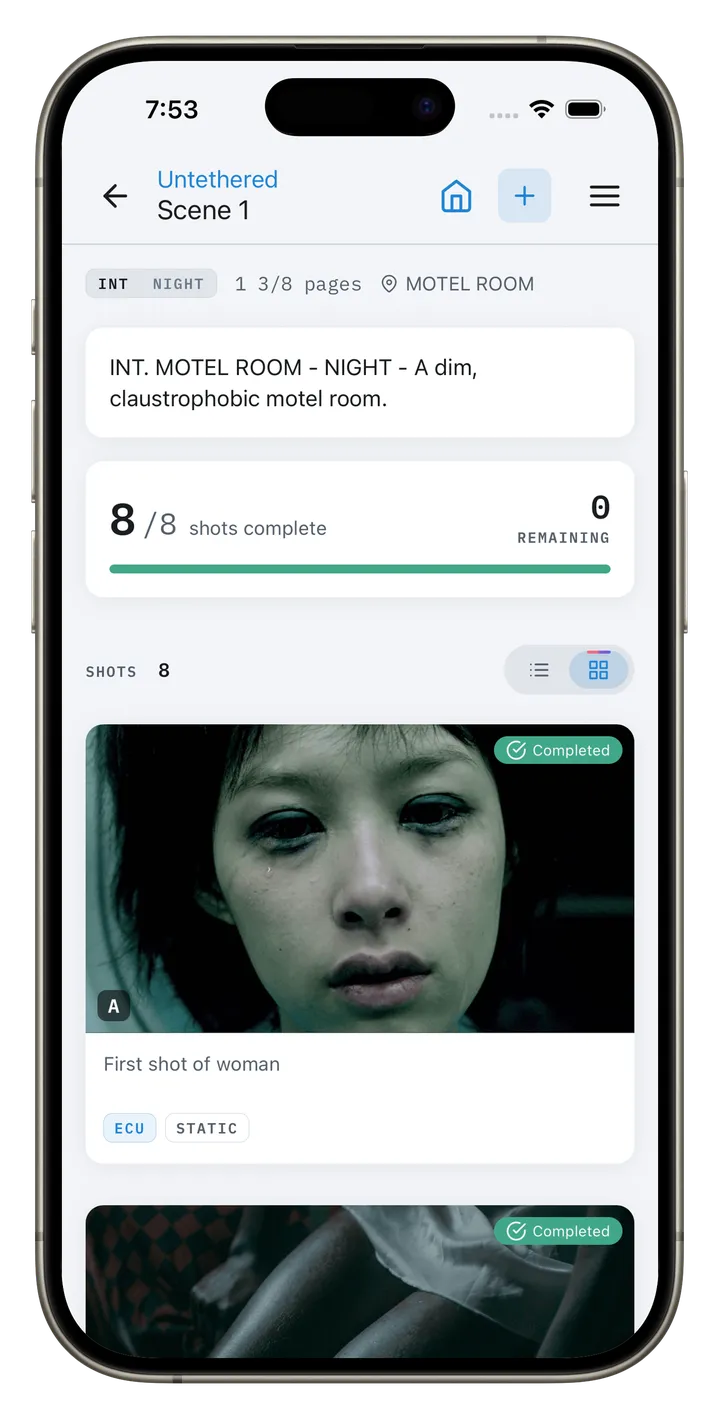
CineFlo covers script import and breakdown, shot lists, scouting, stripboard scheduling and call sheets with confirmation tracking, which is the middle of that table rather than the specialist ends.
Terms used here: stripboard, page count (eighths), day out of days.
Frequently Asked Questions
How long does pre-production take?
About a week for a one-day shoot, four to eight weeks for a short film, eight to twelve for an independent feature, and months of research for a documentary before the first interview. The floor is usually set by financing closing and cast availability, not by how fast the paperwork gets done.
What is on a film pre-production checklist?
Script lock, script breakdown, schedule, budget, key crew hires, casting, location scouting and agreements, art department start, permits and insurance, storyboards, shot list, tech scout, gear package, and call sheets — in dependency order, since several of these block the others.
What is the difference between development and pre-production?
Development settles what the film is: the idea, the script, the financing and the package. Pre-production settles how it will actually be made: the breakdown, schedule, budget, cast, crew and locations. Pre-production begins when the script is close enough to lock.
What is the first step in pre-production?
Locking the shooting script and numbering the scenes. Every other step reads from it, and doing anything downstream before the lock means redoing it.
What is a pre-production checklist for a short film?
The same checklist, compressed to four to eight weeks. The steps most often skipped on shorts are insurance and written location agreements, and they are the two with the worst downside.
How do you do pre-production for a documentary?
Replace the script breakdown with a shoot plan — a sheet per interview, location or sequence covering what you need to bring and what access you must secure. Budget months for research and relationship-building before shooting, and treat releases as long-lead items.
What software do you need for pre-production?
None strictly — features have been made on paper. Practically, you need something for the breakdown and schedule, something for the shot list, and something to send call sheets. That can be one tool or three, or a spreadsheet for a small enough show.
Who is responsible for pre-production?
The producer owns it overall, the line producer or UPM owns the budget, and the 1st AD owns the breakdown and schedule. On smaller productions one person often holds all three, which is workable as long as the sequencing is respected.
Key Takeaways
- Pre-production is a dependency graph, not a flat checklist — script lock gates the breakdown, which gates the schedule, which gates the budget.
- Realistic durations: a week for a one-day shoot, four to eight weeks for a short, months of research for a documentary.
- The two things that set the real floor are financing closing and cast availability. Neither compresses.
- Insurance, permits and specialist elements need calendar time, not money — start them as soon as the schedule stabilises.
- Compressed prep fails by doing steps out of order, not by doing fewer of them.
- Documentary replaces breakdown with a shoot plan; commercial adds client approval as a hard dependency; music video swaps eighths for timecode.
- A spreadsheet is the right tool until the same information lives in three places.